Materials and methods
My professional training focused on mainly traditional drawing and carving techniques and I still use these today. I prefer to draw with a pencil and carve with a hammer and chisel. As a result I tend to work with materials that lend themselves to hand carving; softer stones and wood. Saying that, I try to also embrace modern techniques when they will allow greater creative freedom, such as using laser cutting techniques or laying out large quantities of text. There is a sweet spot somewhere between using 'old school' methods and complimenting them with the digital technology that we have available to us today. I still prefer to use my own letterforms rather than pre-existing 'fonts', preferably designing them specifically for each commission. My most overriding goal is that each piece I create is beautiful and entirely unique.
Materials
I work mainly in slate, sandstones and various types of wood. See a bit more info about these various materials below.
Slate
Slate is without a doubt my favourite material to carve. This is sourced from either Wales or Cumbria. Welsh slate is often considered the best, in part because it is a joy to carve (being very soft but still accepting very fine detail). Welsh slate is a typical grey colour, though they also produce a 'heather' slate which is purple-ish in colour. Cumbrian slate is also lovely and I use a lot of this. The most popular is the green slate, this can be very beautiful with its characteristic mineral (quartz etc) swirls and markings running through it. As this is a natural material, however, it is important to understand that we won't know exactly where these markings may be when we order the slate. In a way this is part of its beauty - every piece is absolutely unique. There is also a Cumbrian grey, similar in appearance to Welsh, which I will recommend if you prefer a more consistent stone. Slate is very durable and will not weather as quickly as the softer sandstones. Unsurprisingly, it is one of the most expensive memorial stones.
Sandstone
There is a wide array of both Scottish and UK sandstones suitable for carving. With sandstone it is important to choose one which is fine grained and thus holds fine detail. I tend to leave sandstone lettering unpainted, so will carve deep and design slightly bolder letters to stand out better. They range in colour from red sandstones like Corsehill and St Bees, through to grey/buff and creamier stones. A particular favourite of mine is York stone.
I also use Caithness stone for memorials. While technically a sandstone, this appears dark grey like slate and for some it is a more affordable alternative to slate. The main difference is that it will weather differently - Caithness will often lighten as it weathers, showing a pink-orangey colour where it has a high iron content. I find this quite beautiful but it is not to everyone's taste.
Other stone
Limestone is another option, similar in appearance to sandstones. They can be beautiful and lovely to carve but mainly used in the South of the UK due to the slightly better climate! A great option for internal plaques and memorials though. Similarly, marble is an option. Though they are both formed of calcite, marble tends to be harder and you will see some marble memorials in cemeteries today.
Granite makes up the bulk of the memorials we see in cemeteries today. The majority of these will have been machine cut and designed using monumental masons computer software, with the unfortunate result that they all look remarkably similar. Most clients come to lettercutters like us because they would like something that looks very different to these! There is no denying of course that granite is highly durable, but this also means that it is rarely hand cut (I don't carve granite!) On rare occasions I will take on a granite job but I will design the lettering myself (it will still be sandblasted) and endeavour to make it as unique as I can.
Wood
I love to carve wood and consider it a great shame that our climate just does not allow for long lasting external wood memorials. Saying that, you will see many a wooden memorial bench or indeed wooden memorial in Woodland Burial Grounds. These may not last as long as stone memorials but will last a good number of years. It is simply a different thing, it will need to be maintained more or replaced sooner but you may find the weathering process beautiful too. Wood is also perfectly suitable for interior pieces or memorials. I prefer to use local sustainably sourced wood where possible. I use oak a lot, though my favourites are the various fruitwoods (cherry, lime) which are a joy to carve.
Drawing and design
As part of my formal apprenticeship I was taught to draw and lay out by hand, using the traditional methods of pencil and rubber! This was by far the most beneficial part of my training - carving skill could come later but there is no real way to speed up the learning of drawing and understanding letterforms, spacing and design compositions. There is basically a great deal of standing back, staring and lengthy discussions about what doesn't look right, what is drawing the eye and what can be done about it. Eventually one develops an intuition as well as certain rules which they tend to work by. Every lettering artist and carver is different and that is something to be celebrated - if we were all the same how boring our work would be!
Every commission will begin with some rough scribbly sketches on a piece of paper, which I then work up into a (still rough) scaled sketch for the client to see the general design idea. When it is time to draw up full size I will design an alphabet of letterforms (we may have decided to go for traditional Roman or a more playful dynamic design) and use this to draw up the full size inscription on paper. This is then transferred to the stone for carving.

Carving
The majority of my work is carved by hand in the traditional way using a hammer and chisel. Lettering is v-cut, which helps the lettering to stand out in certain lights. Hand carved lettering always looks its best in a great raking side light, which produces a shadow on one side of the 'V' and can make the lettering really shine. This effect isn't really achievable in sandblasted letters as the blasting technique tends to produce more of a rounded, dished out effect.
I frequently accompany my lettering with some kind of decorative carving. There are a number of different techniques for this carving: incised v-cut carving or relief carving (light or deep). Sometimes a combination of these approaches will be used. If your memorial is to include some decorative carving then we will have a discussion about which kind of carving will be most appropriate for your design.
Decorative carving - incised
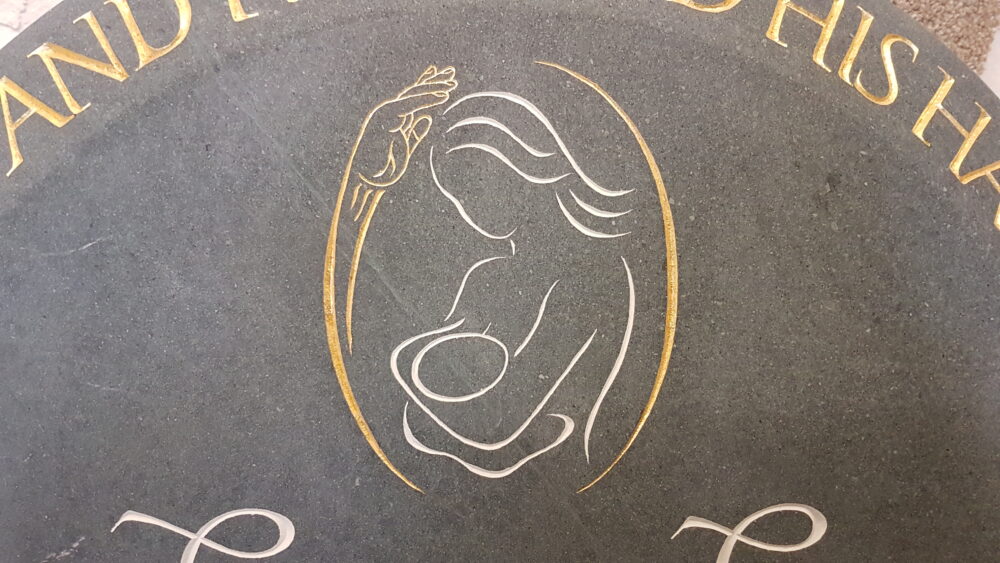
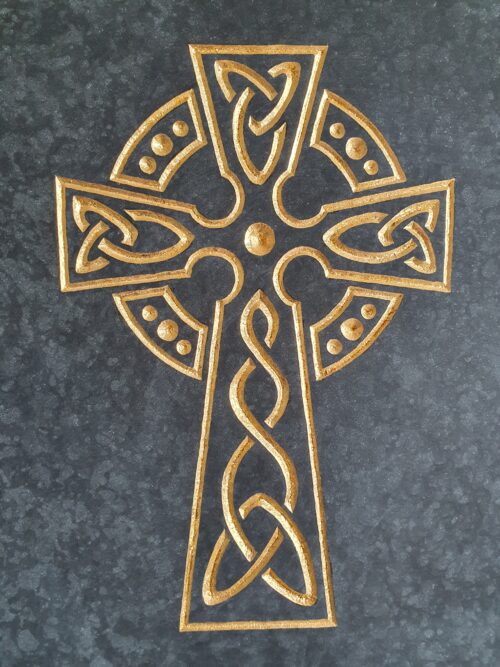
Incised carving simply means carving in the same v-cut manner as the lettering. It is the simplest way of carving, though if the design is small then I may well recommend either painting or gilding the carving for legibility. See some examples of this below.
Decorative carving - relief carving
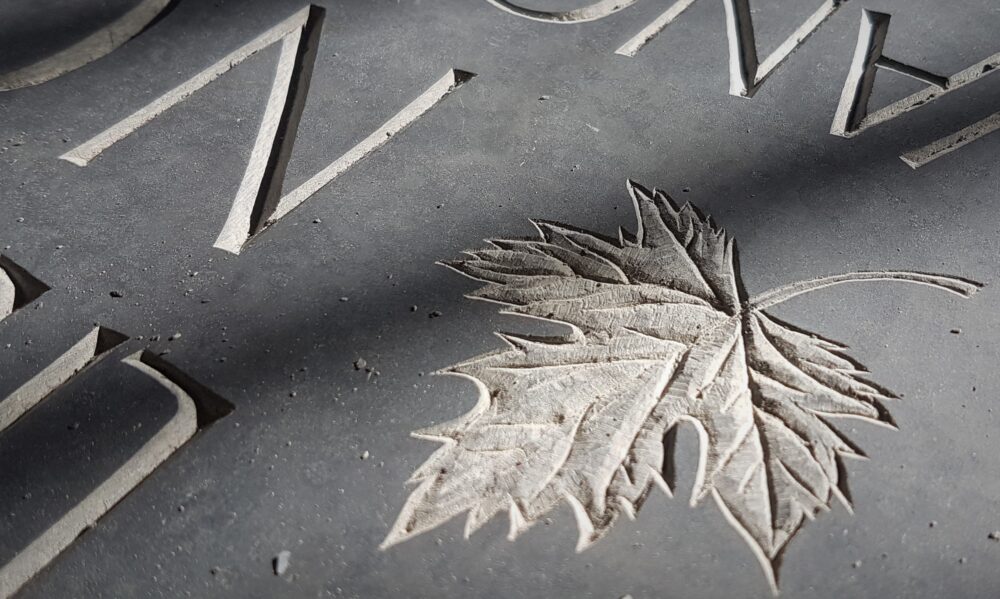
Relief carving means usually carving around the edge of the design so that the the object itself can be carved in more three-dimensionally. Depending on the size, this can be done at different depths. For example, a very light relief carving may have a simple v-cut carved around the outside edge of the object and the 'inside' of the object very lightly carved. See the maple leaf or the kingfisher below. I will carve a deeper relief if, for example, I want to do some decorative carving within a shape like a roundel. I will carve much more deeply around the outside, which will allow me to get more depth into the carving itself. This allows greater detail but also greater legibility. See the two roundels below.

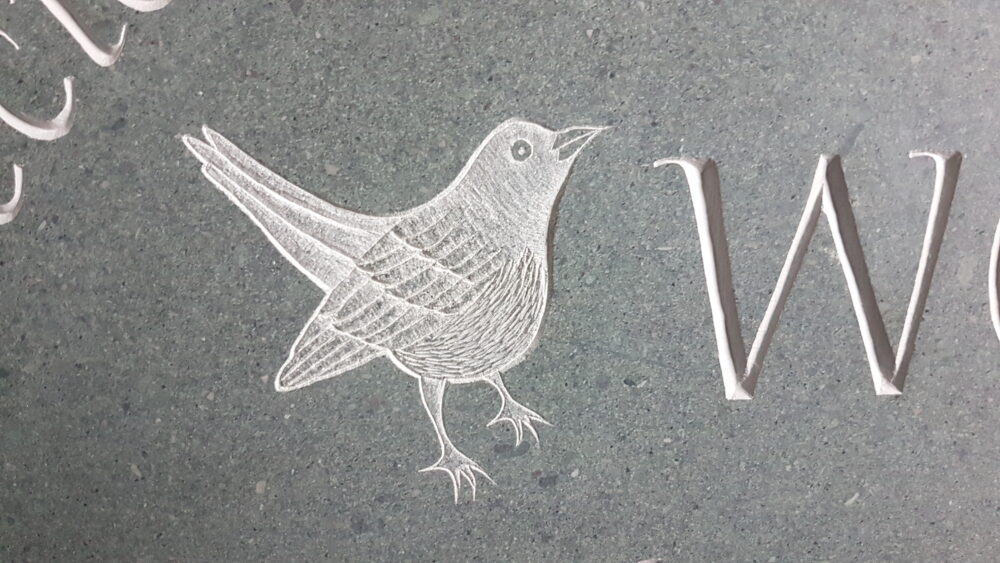

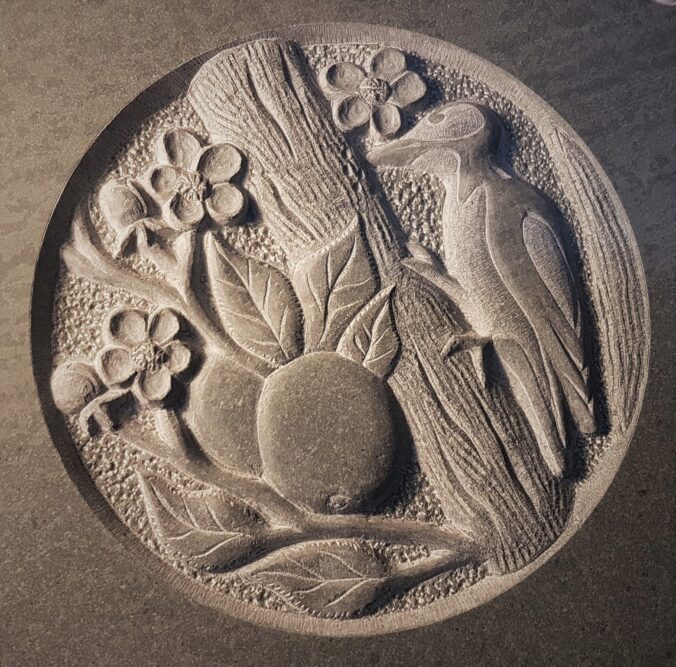

Finishing - paint and gold leaf
When designing your memorial or commission we will discuss whether you would like your lettering or carving to be finished with paint or gold leaf. This is entirely a matter of taste and personally I like both! It is good to know at the start of the process because I may design elements a little differently. For example, if you prefer the carving natural and unpainted then I will design the lettering and carving to be a little bolder or I may suggest deeper relief carving.
Paint
I often choose to paint the lettering on slate or Caithness stone. The main reason being that these stones are so tightly grained that they can be 'flood-painted' - which is a relatively simple process. This means painting over the edges and then using some wet and dry sandpaper to take off the excess when dry. This of course requires a honed/sanded surface so cannot be done on a riven faced stone. It similarly cannot be done on sandstone as it is so porous. There are a number of different paint options. We can use any colour you wish though I tend to prefer a subtle grey colour to simply match the colour of the freshly carved stone (this is lost a bit as the stone weathers). It adds legibility to the lettering and the fine detail (showing up serifs etc which may otherwise be lost) though on the flip side requires a greater accuracy of carving as it will show up any tiny mistakes!
Gold leaf
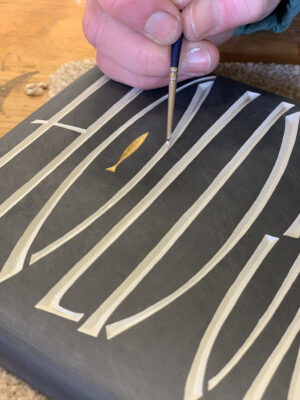
Another option is to gild some or all of your lettering or carved detail. I use 23.5 carat gold leaf with oil sizes that are suitable for external memorials. Alternatively, you may prefer a silver colour and in that case I would suggest Palladium leaf - this looks the same as silver but will not tarnish as silver does when it oxidises. Real gold or palladium leaf is a pleasure to use and I frequently use a wee bit of it on most of my exhibition work! I like to use it in a subtle way to highlight fine details.